
A missed slot: refunds, price top-ups and cancellations after the window shuts
Most missed timed orders end in a refund, a request to pay the difference, or a cancellation. Deciding which you want before you pay saves the round of messages.
When the slot closes before the purchase
When a timed order misses its window, the agent has three usual answers. If the item is gone, the item amount comes back to you. If the item is still for sale at a higher price, the purchaser asks whether you will pay the difference. If the listing changed in some other way, an option removed or a rule added, the order is cancelled or switched with your consent.
The saved CNFans help menu named Returns and Refunds without preserving the detailed terms in that capture. Treat the steps below as a record to assemble and questions to ask, not a promised outcome, refund destination or timetable.
Where a refund usually lands
Agent refunds usually go back to your balance with the agent rather than to the card you paid with. A balance is quick to reuse on another order; getting it back to a card is a separate request with its own terms. The archived CNFans pages named a Top up help article and nothing about withdrawals, so ask the agent which applies before you rely on either.
A refund for an item that was never bought should not include any international shipping, because nothing was shipped. If a domestic delivery charge was added to the order, ask whether it comes back too; that depends on whether the seller ever charged it.
A price top-up request
A top-up request should identify the amount and reason. It does not by itself prove that stock is reserved or that purchase will succeed. Check the exact option and revised quote, and ask what choices and deadlines apply.
State your maximum amount and fallback, then obtain confirmation that the agent can follow them. Do not assume that exceeding a ceiling automatically cancels or refunds the order. Keep the response with the purchase record.
Partial quantities
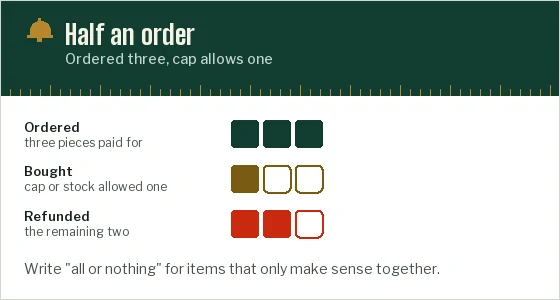
Limits and thin stock can leave an order half done. If you ordered three and the cap or the remaining stock allows one, the purchaser buys one and the rest comes back as a refund. Some customers would rather have none than one; if that is you, say so.
Partial orders matter for sets. Two pieces meant to be worn together, or a size bought in two lengths to compare, lose their point if only one arrives. Mark items that only make sense together, and ask for all or nothing.
Reading the message from the purchaser
Messages about missed slots often quote the listing in Chinese or translate it loosely. The words are few and worth knowing: 已售罄 or 已抢光 means sold out, 活动已结束 means the event has ended, 价格变动 means the price changed, 超出限购 means the quantity is over the limit, and 无法购买 means the item cannot be bought at all.
Each points to a different answer. Sold out leaves only a refund or a second choice. An ended event or a changed price raises the top-up question. Over the limit means a smaller quantity. Cannot be bought often means the listing needs a reservation, a draw entry or a group.
Records worth keeping for a timed order
A missed slot is rarely anyone's fault, but a record makes the conversation shorter. Keep the screenshot of the listing with the timer and your clock visible, a copy of your order note, and the purchaser's message with the price they found. Three pictures settle most questions.
If you think a refund is short, compare in yuan: the item amount you paid against the amount returned. Then ask the agent about any difference, quoting the order number.